Client problem
England’s train commuters are used to these words: Closed for engineering works. Passengers might have to take a slower replacement bus service, or there might be no service at all. And the longer these engineering works go on, the more Network Rail has to pay in compensation to the rail companies. Many argue that ultimately it’s the taxpayer who pays. So when the track bed on 270 metres of the Midland Mainline in Kentish Town (just before the line reaches London St Pancras) got saturated with water, thereby weakening the line, urgent repairs were needed. Tolerance levels on 15 metres of the up line and 25 metres of the down line had to be increased. Because as things stood, trains were being forced to travel at half their normal speeds. The line was in a deep cutting with retaining walls on both sides, which made access more difficult than usual for any contractor to solve the problem. Network Rail contracts the maintenance of its network to contractors, who have certain defined possession periods of track for regular maintenance. Any periods outside that will cost money to Network Rail, and thus to the contractors, such as Osborne taking care of the maintenance.
Alternative solutions
The Customer aim during design phase was to provide a long term solution to stabilise the ground underneath and stop the water ingress with a long term solution, so that the trains could regain their speed.
Jet grouting would have technically done the job more than adequately; however it would have cost ca £3.7k per linear meter, and required large set up area which would have also closed the road adjacent to the deep cutting, and potentially caused noise and environmental hazards. Programme for jet grouting would have required in total 16 weekend blockades with total requirement of 832 hours. The indirect cost to Network Rail of 16 unplanned blockades could have amounted to 7 million pounds.
The other alternatives were hollow drill bars and ground improvement with resin injection. Hollow drill bars would have incurred similar direct cost to jet grouting, with total closure requirement of ca 600 hours.
Resin injection would be performed in 3 men teams during normal week day possession periods, treating 5 linear meters per 6 hour possession. Total programme length would be 45 weekday possessions.
Why was Geobear chosen
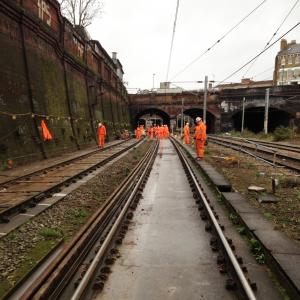 The client engineers had to deliberate for a long time; whether to choose jet grouting or hollow drill bars; both methods that have been around for close to 100 years, with massive direct and indirect costs. Resin injection as challenging alternative has been around in UK since 1989, with over 10,000 projects completed, so even though the method is not as used as jet grouting, it has been widely proven. Engineers were finally satisfied of the design parameters, longevity documentation and project management competence of Geobear, and after that the choice was easy.
Results
The concrete track bed was treated according to the design, and water saturation decreased accordingly with improved stability. Each repaired section was ready for trains the following morning, since the geopolymer acts quickly. That was good news not only for passengers. Geobear was able to do the work without closing the line – arguably saving the economy over £100 million by avoiding 16 weekend blockades. The customer saved money, too. Geobear’s work took a fraction of the time it would have taken builders, and there was no need for costly equipment such as cranes or drill rigs. The customer also got peace of mind. With Geobear, there was no risk of using materials harmful to the environment, and there was no construction site, therefore little noise – an important consideration in residential northwest London. Geobear kept things running, and kept the customer and passengers smiling.
You can read more about Geobear’s track and rail work here.
